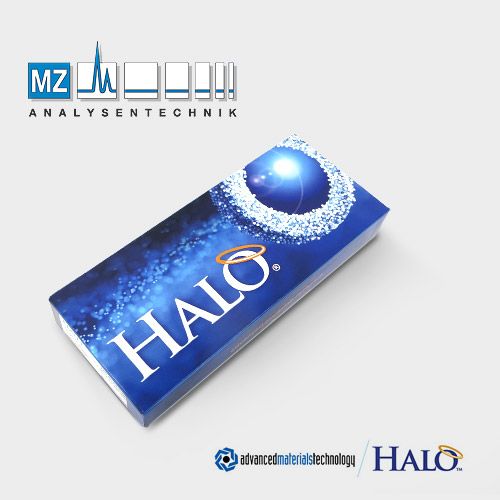
HALO® Inert Hardware
HALO® Inert hardware introduces a surface-passivated barrier between the sample and stainless-steel column components. This minimizes interaction of the analyte with metallic surfaces which is a common cause for sample loss, peak tailing and poor reproducability of results.
Strengths
The most significant advantage is improved recovery for analytes known to adsorb onto metal surfaces, including phosphorylated compounds, chelators, and biomolecules. AMT reports approximately 40% higher peak area and 40% lower tailing factors compared with conventional stainless-steel hardware for hydrocortisone sodium phosphate.
Additional benefits include:
HALO® OLIGO C18
HALO® OLIGO C18 was specifically developed for oligonucleotide analysis. The column combines Fused-Core particle technology with an alkaline-resistant organo-silane surface chemistry and inert hardware. Available in both 120 Å and 1000 Å pore sizes, it addresses separations ranging from short oligos to large therapeutic oligonucleotides.
Strengths
The column is optimized for conditions commonly used in ion-pair reversed-phase oligonucleotide chromatography:
Performance data show rapid separation of oligonucleotide ladders in under 3.5 minutes while maintaining excellent resolution and peak shape. AMT also demonstrates superior behavior versus a competing oligonucleotide column, where longer oligonucleotides exhibited substantially less tailing on the HALO® OLIGO C18.
The introduction of the 1000 Å pore size extends applicability to larger oligonucleotides and siRNA-related impurity profiling.
HALO® Elevate C18
HALO® Elevate C18 was designed to overcome the pH limitations associated with many silica-based reversed-phase columns. Through surface-modified organo-silane chemistry, the column offers a broad pH operating range of 2–12 while maintaining the efficiency associated with Fused-Core® particles.
Strengths
The primary advantage is exceptional alkaline stability. High-pH mobile phases are often preferred for basic compounds because they suppress secondary interactions and improve peak shape. HALO® Elevate allows analysts to exploit these conditions without rapid column degradation.
Key benefits include:
HALO® PCS
HALO® PCS (Positively Charged Surface) columns incorporate a positively charged surface chemistry intended to improve the chromatographic behavior of basic compounds. Available in both C18 and Phenyl-Hexyl formats, the technology addresses one of the most common chromatographic problems: tailing peaks for protonated analytes.
Strengths
The positively charged surface reduces undesirable interactions with residual silanol groups and improves peak symmetry under low ionic-strength mobile phase conditions. Benefits include:
The availability of both 90 Å and 160 Å pore sizes broadens applicability from small molecules to peptides.
Reach thousands of researchers worldwide. Fill in your details and our team will contact you shortly.